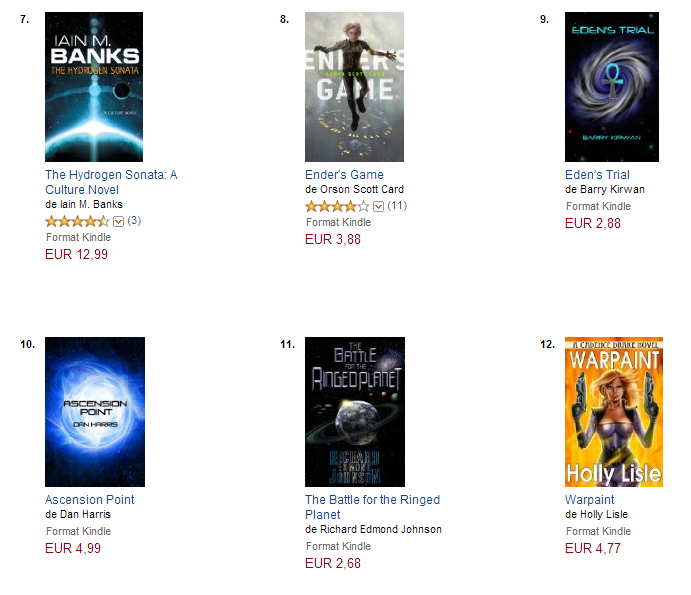
Les meilleures ventes en Space Operas

Ascension Point has stormed into the top ten of the Amazon.fr English-language Space Opera bestsellers’ list, and is rubbing shoulders with Iain M. Banks’ Hydrogen Sonata and Orson Scott Card’s Enders’ Game!

frtopten


(And a novel called WARPAINT, which I’ve not heard of before, but find oddly compelling for some reason.)

And what glut of sales do I have to thank for this new-found popularity, I hear you ask? Well, I’ll tell you.

I sold one copy.

In five months.

So… I guess they’re not reading a lot of English space opera in France.

…And Back to Normal

Just a quick update as promised: it looks like the sales bump from Book of the Day ad has now ended. The final tally was eighty-two sales on the day of the ad, twenty-two the day after, and just the one today. 105 total, which is 30 more than I needed to break even. Yay!

Here’s hoping a few more readers take the plunge over the next few days and grab a copy while Ascension Point loiters near the top of the Amazon Space Opera bestseller list, and that I get a nice big tranche of new customer reviews from all of these lovely sales. All in all, well worth it.

Long Arc, Short Arc: Episodic Storytelling

There’s a new fad in sci-fi at the moment, which is actually a very old one: serialisation. The mighty John Scalzi is releasing The Human Division, the latest book in the Old Man’s War series, in episodic format. Each episode of around ten thousand words or thirty pages is being released one-by-one in ebook format for 99c, and there will be a bundled compilation–the whole book in one, basically–once the series is complete.

Reading about this got me thinking about episodic storytelling. It used to be a very common format in literature back in the days when newspapers and magazines were the predominant form of media. Arthur Conan Doyle’s Sherlock Holmes stories are probably the most famous example; they ran in The Strand magazine from 1891 to 1930, with a brief interruption after Conan Doyle had attempted to kill off his hero, before outraged fans demanded his return.
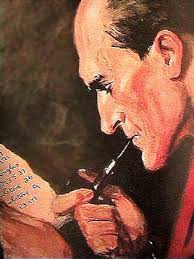
(If you think fanboy rage was born with the Internet, you’re mistaken.)

But in recent decades it’s obviously television that’s taken up the mantle of episodic storytelling. Phenomenal, wonderful stories have been doled out, week by week, one hour at a time, with the best shows every bit the equal of classic literature. The Sopranos, The Wire and now Breaking Bad; each of them cast a bright, often harsh light on society and the human condition, with vivid characterisation and gripping, often shocking plotlines.

The reason the episodic, serial format interests me is the way in which the writer–to write episodically in a way that’s satisfying and compelling–must mesh two types of story arc.

The first is the macro, the long arcs of both plot and character which carry across an entire season, or series. The ‘big story’ if you like. A novel typically contains just these arcs, to take the reader from the start of the book to the end. The protagonist leaves home, kills the dragon, and learns something about herself along the way, in a nutshell.

The second is the micro, the arc of the story across a single episode. In television this arc can either be well-bounded and easily recognisable, in the case of a procedural series such as CSI or Castle; or more closely entwined with the macro long arc, as in ‘serialized’ shows such as Lost24 and the three aforementioned modern classics. (More on the distinction here.)

The challenge is in their combination. In telling a satisfying story that can stand on it’s own, setup, action and conclusion all wrapped up within the hour, or the thirty pages; but also developing those characters along their personal series arcs, and progressing the broader overarching plot, at the same time. It can’t be easy, and I’ve developed a newfound respect for television writers who pull this off week after week, season after season.

So what am I going to do about it? Well, I’m going to write a series, of course!

For the foreseeable future most of my writing focus will continue to be on my novels–Venus Rising will be out in April, then I’ll start on the draft of the third book which is already outlined, with a fourth to wrap up The Unity Sequence coming after that–but I’m also going to start noodling away at a series. I’m not sure yet if it’ll be episodic literature in the style of Scalzi’s The Human Division, or my first foray into screenwriting, but likely the latter; I think shifting between prose to script will provide some refreshing variety, and I’ve always wanted to give screenwriting a try.

‘But Dan, what’s the point? You’ll never get a TV show optioned. You have to know people and–‘

I’ll cut you off there, my imaginary friend. Because it seems that indie publishing catalyst and retail behemoth Amazon is now in the studio business, too. All pitches welcome. Come one, come all–you don’t need to know anybody, you just need a good enough story. Man, it’s a great time to be a writer.

But what about you, dear reader: are you an enthusiastic consumer of episodes, or do you prefer a single, longer story? Or do you just combine the two and binge-watch an entire season of Homeland on a rainy Sunday?

Should I Be Giving My Books Away?

Amanda Palmer–alt-rock music star and wife of fantastical writing genius Neil Gaiman–did a talk for TED on ‘The Art of Asking’. The synopsis from TED:

“Don’t make people pay for music, says Amanda Palmer: Let them. In a passionate talk that begins in her days as a street performer (drop a dollar in the hat for the Eight-Foot Bride!), she examines the new relationship between artist and fan.”

Amanda and her band famously used Kickstarter to fund production of their new album, asking fans to contribute a total of $100,000. They ended up with $1.2M, donated by only 25,000 people at an average of almost fifty dollars a piece. Astounding.

Unlike Amanda, I’d hesitate to call myself an artist–it seems a bit pretentious, for some reason–but watching this made me think, as the parallels between music and books are obvious. The digital indie publishing revolution has brought writers closer to their readers than ever before, tearing down the barriers and hurdles of finding agency and publisher representation, of shipping physical copies to a bookstore.

What’s to stop me posting a new novel here, on my website, available to anyone to download for free? With just a PayPal or Google Checkout button next to it with a message saying “If you enjoyed this book, you can help me out here. Thanks.”

Nothing. There are no barriers.

But should I do that? It’s early days in my writing career, but I have a certain amount of confidence that ten or twenty years or novels down the line I might be able to make enough from my current, standard indie pub model that I could make a living at it. (Industry changes permitting, of course.) And if I did make that living, why would I change?

Might doing so make me richer? Would some deep-pocketed fans happily download one of my books, and give me $20 in exchange? $50?

Would it make me more famous? Would I care if it did? Would I even like it if it did?

Would TED invite me to do a talk? (That would be cool.)

I don’t know the answer to any of these questions.

Writers, would you consider giving away your work and trusting in the generosity of strangers and fans to pay your bills? Why? Do you yearn for the emotional connection to fans that Amanda talked about?

Readers, would you donate before you read, or happily accept a freebie? Or maybe come back and chip in what you thought the story was worth once you’d read it? Or maybe you prefer the Amazon shopping experience with eight million books at your fingertips, rather than having to traipse over to every individual author’s website to pick up your latest read.

What are your thoughts, folks?

Venus Rising: To The Editor!

I just sent the MS for Venus Rising to Lynn at Red Adept, and Misti–my editor–will be starting her edit this week. Very exciting. The process took about a month for Ascension Point, from Misti’s first look to the final proofread version, so if things go similarly well we’re looking at an early April release.

I’m a bit more organised for this release than I was the last time; namely, I already have the paperback cover and blurb ready, so I’ll be releasing all versions at the same time rather than over a few weeks. It’s a little more professional, and also gives all of my potential readers their choice of edition right from the off.

Then it’s on to book three! Rinse, repeat.

In The (SFF) News This Week…

A super-nerdy but awesome explanation of the Kardashev scale, which is ‘used to classify hypothetical alien civilizations according to the amount of energy at their disposal’.

‘This led him to speculate about a Type II civilization. For an [extraterrestrial intelligence] to reach K2, it would need to capture the entire energy output of its parent star. The best way to achieve this, of course, is to build a Dyson Sphere.

Conjured by Freeman Dyson in 1959, this hypothetical megastructure would envelope a star at a distance of 1 AU and cover an inconceivably large area of 2.72 x 10¹⁷ km2, which is around 600 million times the surface area of the Earth. The sun has an energy output of around 4 x 1026 Watts, of which most would be available to do useful work.’

As anyone who’s read Ascension Point knows, I’ve always been more of a Dyson Swarm kind of guy, but each to their own.

Next up, are you ready for season three of Game of Thrones? I know I am.

We should stop using nuclear weapons as a unit of measurement, says annoyed atomic historian.

“In general,” he added, “What I don’t like is … the idea that kiloton or a megaton is just an energy unit, that it’s equivalent to so many joules or something. Because you could do that. You could claim that your house runs so many tons of TNT worth of electricity per year, but it sort of trivializes the notion.”

Also at The Atlantic, a spectacular NASA video of three simultaneous solar phenomena.

…a solar flare, a coronal mass ejection (CME), and coronal rain, “complex moving structures in association with changes in magnetic field lines that loop up into the sun’s atmosphere,” NASA explains.’

Finally, in Dan-specific news, Venus Rising goes to my editor on March 8th, which means it should be out in just a couple of months!